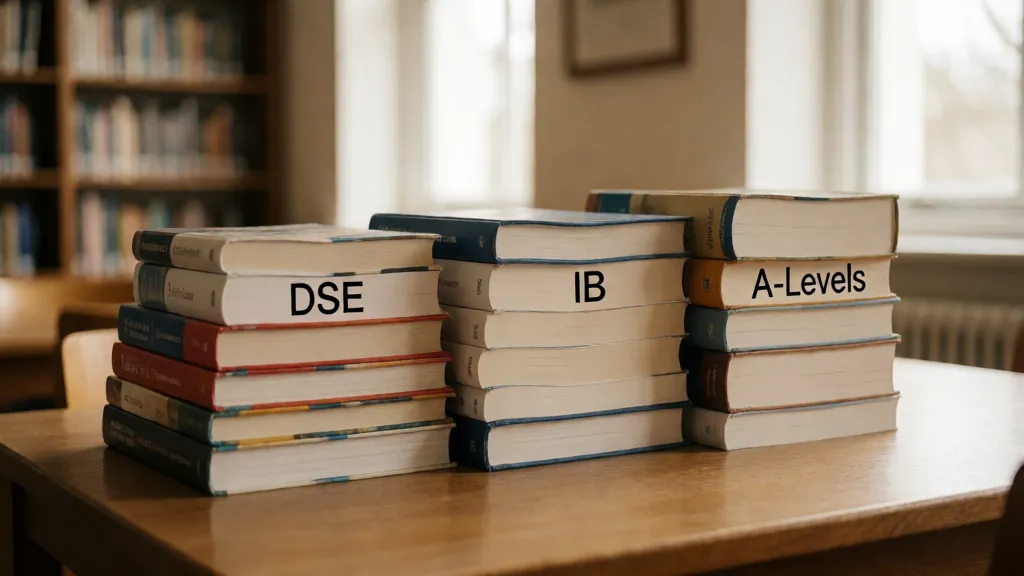
DSE, IB or A-Levels in Hong Kong: Choosing a Curriculum Without the Folklore
Hong Kong families with the means to choose face a genuine three-way curriculum decision: the local DSE, the International Baccalaureate Diploma offered by international and some DSS schools, and international A-levels offered by international schools and private candidature. Each route leads to good universities; each suits a different child and family situation. What follows compares them on the dimensions that actually decide the choice — noting that recognition rules and school offerings change, and families should verify with the universities and schools concerned.
What each curriculum is like
The DSE is broad and examination-concentrated: four cores including Chinese Language, plus electives, assessed overwhelmingly at the end of Secondary 6. The IB Diploma spreads assessment across six subject groups plus the core of Theory of Knowledge, the Extended Essay and CAS, with substantial coursework throughout — it rewards organised, consistent students and punishes procrastinators gently but continuously. A-levels sit between: typically three or four subjects studied in depth, with a modular feel and the narrowest breadth requirement, which suits students with a defined direction who want to shed subjects they dislike.
Cost: the least discussed decisive factor
The DSE in a public or aided school is close to free. The IB and A-level routes in Hong Kong run through international and private schools whose fees commonly reach into six figures of Hong Kong dollars per year, frequently with debentures or capital levies on top, sustained over five to seven years. For most families this is the real decision: the marginal university-admission benefit of an international curriculum rarely justifies financial strain, because the DSE is a fully recognised route to the same destinations.
University recognition, honestly stated
- Local universities: DSE students apply through JUPAS, where the vast majority of publicly funded places flow. IB and A-level students apply through the non-JUPAS route — workable and well-trodden, but a different competition for a smaller pool of places.
- UK universities: all three are fully recognised; A-levels and IB are natively familiar, and the DSE carries published tariff equivalences.
- US universities: holistic admission blunts curriculum differences; IB's breadth narrates well, but strong DSE candidates are admitted every year.
- The pattern overall: recognition is rarely the true differentiator between these routes. The child's fit with the curriculum's working style, and the family's finances, are what genuinely separate the outcomes.
Which child suits which route
The DSE suits students strong in Chinese — a core there, an option elsewhere — and families wanting local university access at minimal cost. The IB suits organised all-rounders who write willingly and can sustain coursework across two years. A-levels suit early specialisers who want depth in three or four subjects and the option of private, flexible study. The commonest mismatch is placing a weak-Chinese student on the DSE track, where the Chinese core throttles eligibility, or a disorganised student into the IB, where the coursework calendar does the throttling.
Switching: possible, but time it
- The natural switching window is the end of Secondary 3 or its equivalent, before senior curricula begin — later moves force syllabus catch-up under time pressure.
- Switching away from the DSE after Secondary 4 wastes elective progress; switching into it late collides with the Chinese Language core, the hardest gap for returnee and international-stream students to close.
- Trial the destination first: a term of IB-style coursework demands, or of DSE Chinese papers, teaches more than any open day.
- Tutors advising switchers should audit gaps subject by subject against the target syllabus rather than reassuring in general terms.
Strip away the folklore and the decision usually reduces to three questions: can the family sustain the cost without strain, is the child's Chinese strong enough for the DSE core, and does the child's working style favour terminal examinations or continuous coursework. Families that answer those three honestly rarely regret the choice — under any of the three flags. And whichever route is chosen, choose it early enough to commit: children thrive on a settled track far more than on a theoretically optimal one revisited every year.
- Hong Kong Examinations and Assessment Authority — HKDSE recognition information — www.hkeaa.edu.hk
- JUPAS — Joint University Programmes Admissions System — www.jupas.edu.hk
- Education Bureau, HKSAR — school information — www.edb.gov.hk