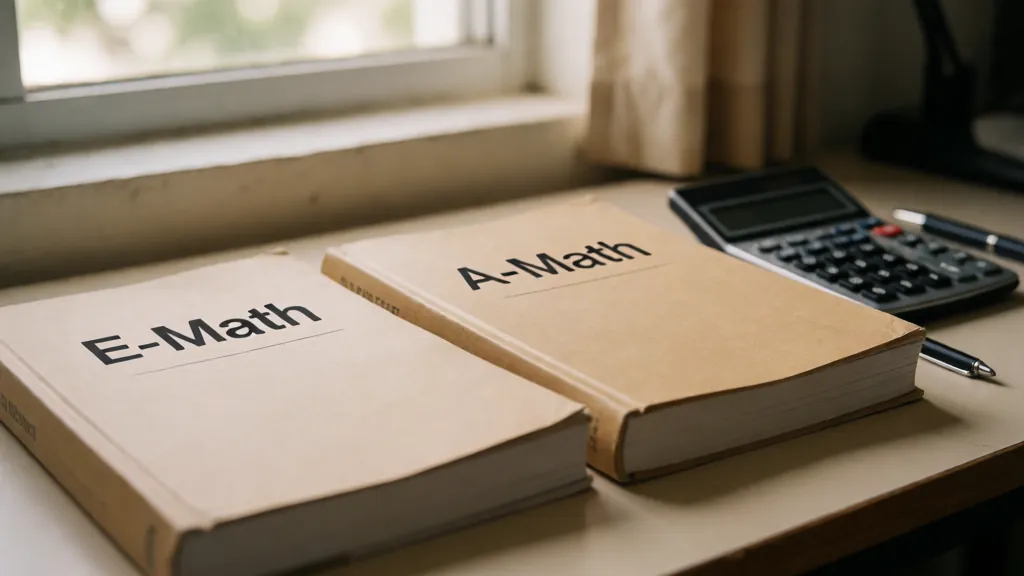
E-Math vs A-Math: What the Difference Really Is and Who Should Take Both
Around the end of Secondary 2, many families face the same question: should my child take Additional Mathematics on top of Elementary Mathematics? The names invite a misunderstanding — A-Math is not a harder version of the same subject, but a different subject with a different style of thinking. Getting this decision right matters for two years of workload and, for some students, for post-secondary options.
What each subject actually is
Elementary Mathematics (E-Math) is the compulsory mathematics subject. It covers numbers, algebra, geometry, mensuration, trigonometry, coordinate geometry, statistics and probability, with a strong emphasis on real-world application — questions about taxes, hire purchase, maps, and interpreting data are typical. It is broad, practical and computational.
Additional Mathematics (A-Math) is an optional subject taken alongside E-Math, covering algebra in much greater depth — quadratic functions, polynomials, partial fractions, binomial theorem, logarithms and exponentials — plus proper trigonometric identities and equations, and an introduction to calculus: differentiation and integration with applications. It is narrower than E-Math but far deeper, and its questions are multi-step and abstract, frequently requiring proof or manipulation with no numbers in sight.
The real difference: style of thinking
E-Math questions mostly ask students to select a known method and execute it carefully. A-Math questions routinely require chaining several techniques, recognising structure — spotting that an expression is a disguised quadratic, or that an identity will simplify a trigonometric equation — and persisting through longer working. Students describe the difference accurately when they say E-Math tests carefulness and A-Math tests problem-solving.
Who should take A-Math
- Students aiming for JC science combinations: H2 Mathematics assumes A-Math fluency, and many JCs expect or strongly prefer an A-Math background for it.
- Students eyeing engineering, science or mathematics-heavy polytechnic diplomas and, later, related university courses — the calculus foundation pays off repeatedly.
- Students who genuinely enjoy mathematics: A-Math is where the subject starts to feel like real mathematics rather than arithmetic with contexts.
Conversely, a student struggling to stay afloat in E-Math at Secondary 2 usually should not add A-Math on prestige grounds. A strong E-Math grade serves aggregate scores better than a weak pair, and pathways into business, humanities and design courses rarely require A-Math. School criteria for offering the subject vary; the conversation with the child's mathematics teacher is worth having early.
How preparation differs
For E-Math
Preparation is about coverage and accuracy: the syllabus is wide, so topical revision with a checklist matters, and marks are lost mainly to carelessness — units, rounding to the required precision, misread contexts. Timed practice with an error log targeting careless patterns typically moves E-Math grades faster than more content revision does.
For A-Math
Preparation is about depth and fluency: fewer topics, each needing many repetitions until manipulation is automatic. Algebraic fluency is the load-bearing wall — most A-Math failure is really algebra failure surfacing in trigonometry or calculus clothing. Students should do harder multi-part questions regularly, write full working, and revisit earlier topics constantly because A-Math is cumulative in a way E-Math is not: term two's calculus leans directly on term one's algebra.
Common struggles and how to respond
- The Secondary 3 shock: A-Math's pace and abstraction jump immediately. Respond early — a backlog by June of Secondary 3 rarely clears itself.
- Identity and proof questions: students trained on compute-the-answer questions freeze when asked to show a result. Teach working from one side systematically.
- Mixing up the two subjects' expectations: using A-Math machinery on E-Math questions wastes time, while E-Math habits (jumping to numbers) fail on A-Math structure.
- Calculus rushed at the end of Secondary 4: it carries substantial weight, so front-load practice rather than treating it as a final-term topic.
Take A-Math for where the child is going, not for how it looks — and decide based on Secondary 2 evidence, not hope.
As with all national examinations, syllabuses and assessment formats are maintained by SEAB and schools apply their own subject-offer criteria, so confirm current details for your child's cohort and school.
- Singapore Examinations and Assessment Board — syllabuses and examination formats. — www.seab.gov.sg
- Ministry of Education, Singapore — official curriculum and examination information. — www.moe.gov.sg