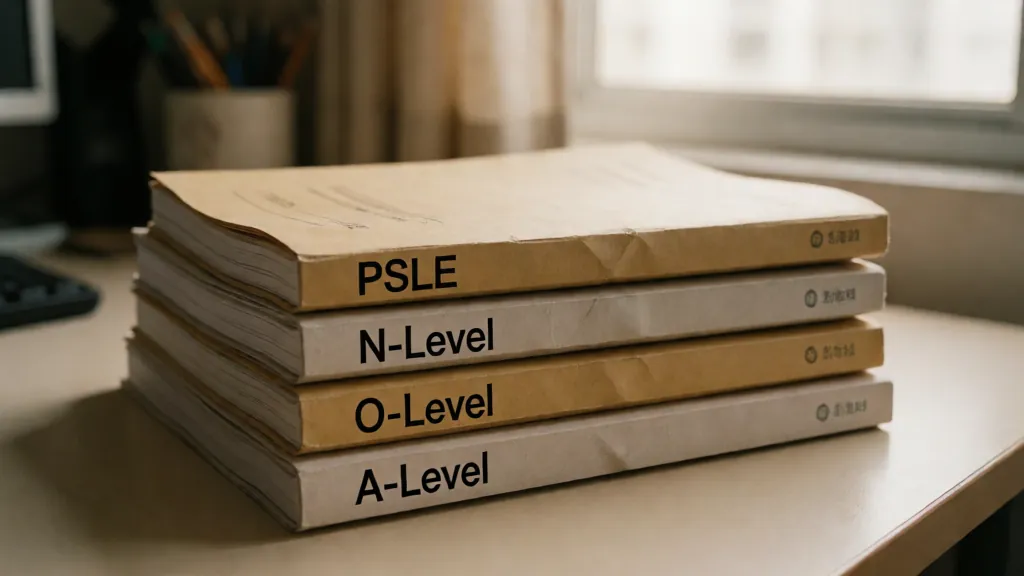
PSLE, N-Levels, O-Levels and A-Levels: How Singapore's National Exams Fit Together
Singapore's education system is exam-marked at several key transitions, and the alphabet soup — PSLE, AL scores, N(A), N(T), O-Levels, H1/H2/H3 — can be genuinely confusing, especially for parents navigating it for the first time. This guide maps the system end to end in plain language. (Details evolve over the years, so always confirm specifics with MOE and SEAB for your child's cohort.)
PSLE — the end of primary school
The Primary School Leaving Examination is taken at the end of Primary 6, usually around age 12, in four subjects: English, Mother Tongue, Mathematics and Science. Since 2021, each subject is graded in Achievement Levels from AL1 (best) to AL8, and the four ALs are added to give a total between 4 and 32 — lower is better. This AL total is the main input for secondary school posting, alongside choice order and, where relevant, higher mother tongue results.
The AL system replaced the old T-score deliberately: grading now reflects a pupil's own attainment bands rather than a fine-grained ranking against the entire cohort. In practice this means broad mastery across all four subjects matters more than squeezing the last mark out of a strong subject.
Secondary school and Full Subject-Based Banding
The old Express/Normal(Academic)/Normal(Technical) streams have been replaced by Full Subject-Based Banding (FSBB). Students now take subjects at three levels — G1, G2 and G3, broadly corresponding to the former N(T), N(A) and Express standards — and can take different subjects at different levels based on their strengths. A student might take G3 Mathematics alongside G2 English, rather than being placed in a single stream for everything.
O-Levels and the Singapore-Cambridge Secondary certificate
At the end of secondary school, students sit national examinations — from 2027, cohorts receive the combined Singapore-Cambridge Secondary Education Certificate (SEC) reflecting the subject levels taken. O-Level-standard (G3) subjects are graded from A1 to F9, with A1 the best; the familiar aggregate scores such as L1R5 (one language plus five relevant subjects) are used for admission to junior colleges, while polytechnics use ELR2B2. Lower aggregates are better, and bonus points for co-curricular achievement can adjust them.
Post-secondary pathways
- Junior College (2 years) leading to A-Levels — the traditional academic route to university.
- Millennia Institute (3 years) — an alternative A-Level route with a slightly longer runway.
- Polytechnic (3 years) — diploma courses with an applied focus; strong diploma holders progress to local universities, often with module exemptions.
- ITE — Nitec and Higher Nitec certification, with progression routes into polytechnic diplomas.
It is worth saying clearly: the polytechnic route to university is well-trodden, and choosing it over JC is a question of learning style and career direction, not of ability. Some disciplines — design, engineering practice, media — are arguably better entered through a diploma.
A-Levels: H1, H2 and H3
The Singapore-Cambridge A-Levels are structured by depth. H2 subjects are the full-depth core — most students take three or four. H1 subjects cover about half the content depth, and every student takes H1 General Paper (or Knowledge & Inquiry) plus Project Work. H3 is optional extension work for students who want to go beyond the H2 syllabus in a subject. University admission is computed from a rank point system: with three H2s and one H1 plus GP and PW, the maximum University Admission Score is 90 rank points. From the 2026 A-Level cohort onwards, Project Work becomes pass/fail and the maximum computed score adjusts accordingly.
What this means for planning
- Each checkpoint measures a band, not a destiny — the system has been repeatedly redesigned (ALs, FSBB, SEC) precisely to widen paths, not narrow them.
- Subject-level choices under FSBB and JC subject combinations both reward honest assessment of strengths over prestige-chasing.
- Exam formats and syllabuses are published by SEAB; past papers and the official syllabus documents are the single most underused free resource available to families.
- Ministry of Education, Singapore — official curriculum and examination information. — www.moe.gov.sg
- Singapore Examinations and Assessment Board — syllabuses and examination formats. — www.seab.gov.sg